
How to Use AI Tools Between Therapy Sessions
Track mood and stress between therapy sessions and decide what to bring to your therapist. Stephanie Levitt and Scott Enrico discuss where AI can help.
“Can we talk tomorrow?” Four words can take up the rest of an evening. You know someone wants to talk. Everything else you might hear in that message, from disappointment to the end of a relationship, comes from somewhere outside those four words. Asking a chatbot what the sender meant can bring an answer in seconds. A better question might be, “What am I assuming, and what could I ask them?” That leaves room for the person who sent the text to answer. If the exchange stays with you, jot down what you assumed and what happened when you asked. That gives you and your therapist a specific moment to discuss at your next session.
A stressful text was one of the examples in KYMA reporter Adrik Vargas’s September 7, 2026, story about AI and mental health. Two days later in Baton Rouge, Louisiana First News reporter Melanie Lowe asked what happens when people begin to count on the technology for companionship. Both reporters spoke with the co-founders of AI Powered Therapist, Stephanie Levitt, MA, LPC, NCC, a licensed professional counselor who founded Pathways Counseling Services in Scottsdale, and Scott Enrico, the developer behind APT. Their two conversations followed the same technology into different moments of someone’s life. In one, the user has a specific question and a conversation to get back to. In the other, the chat itself can become the place they return for comfort.
What a chatbot can do with a stressful text
Levitt told KYMA that she saw a place for AI in the days between therapy appointments. Vargas described tools that help people work through worries, including ones that arise when they read a text. Enrico acknowledged that AI makes mistakes. Those points belong together. The same ability that makes a chatbot good at suggesting several possible replies also makes it good at inventing a convincing backstory for a message whose author it has never met. Read Adrik Vargas’s KYMA report.
 Play the KYMA interviewClose player
Take that invitation to talk tomorrow. A reply such as “They’re probably upset with you” can feel perceptive if you were already worried. It adds no evidence. You could give the chatbot a smaller task by asking, “Can you help me write one question about what they’d like to discuss?” You might end up with, “Sure. Is there anything you’d like me to think about beforehand?” Read it aloud. If it sounds too formal for someone you know, edit it. You can also close the chat and call the person. Either way, you decide what you actually want to say.
There may be something worth bringing to your next appointment even if the conversation turns out to be about picking someone up at the airport. You could jot down, “I assumed I was in trouble and spent an hour drafting a reply.” A therapist can ask what that hour was like and whether you remember feeling that way in another relationship. The observation is yours. A single sentence in your own words can give you a starting point without handing over an entire private exchange.
When KYMA aired its report on September 7, California lawmakers had already passed Senate Bill 903, a proposal to restrict how AI could be used in psychotherapy. Governor Gavin Newsom vetoed the bill on September 30. The question raised by that debate still makes sense for an individual user. When an answer sounds like a professional opinion, who has actually assessed your situation, and whom can you ask to explain it? Read the governor’s legislative update.
When the chat starts to feel like company
In Baton Rouge, Lowe reported that one in ten American adults had used a chatbot for emotional support or advice. Among adults ages 18 to 29, the figure was one in five. Those Pew Research Center survey figures count people who have used a tool this way. Someone who tried a chatbot once after an argument and someone who opens it every night could both answer yes. The numbers tell us why it’s worth asking what the interaction looks like for the person having it. Watch Melanie Lowe’s Louisiana First News segment.
 Play the Louisiana First interviewClose player
Enrico spoke to Lowe about how understandable it is for someone who feels lonely to come back to a chatbot that feels like a friend. His concern was how easily that could turn into reliance. Think about an evening when you miss someone. It’s one thing to ask for help drafting an invitation, set the phone down and send “Coffee on Saturday?” in your own words. It’s worth paying attention if, over several evenings, you keep writing to the chatbot about how much you miss your friend and the invitation stays unsent.
Lowe also spoke with Sherrard Crespo, a licensed clinical social worker, who emphasized the need for human contact in a crisis. That point changes what a reader should expect of even the most carefully worded chat response. A reply on a screen does not establish that anyone has seen your message or knows where you are. If you need someone with you, say that plainly to a person who can respond. In immediate danger, contact emergency services directly.
For an ordinary hard evening, a useful question to ask before opening the chat is, “What would I like to be able to do when I put this down?” Your answer might be to ask a friend to call, to write down something you keep forgetting in therapy, or simply to let an ambiguous text wait until morning. Each gives the conversation a place to end.
Which AI tool fits what you need today?
The easiest way to choose among AI Powered Therapist’s tools is to start with the job you want help doing. Do you want to understand a single message? Make sense of an argument after it’s over? Catch your breath before going back into a meeting? Each calls for something different. Here’s how the tools work, with examples you can adapt or ignore.
“I can’t even put my question into words.”
The Clarity Guide is the front door for adults who want to start by talking or typing. You can begin with an untidy account of what happened. Try “I agreed to help out again, and now I’m annoyed with everyone, including myself.” Ask for one question that would help you sort out what bothers you. Sometimes it turns out you’re willing to help and angry that everyone assumed you would. That distinction gives you a much more useful subject for a conversation than trying to decide whether you’re a generous person.
My Companion leaves more room for an open-ended reflection. One of its invitations is to hold on to a good moment. A person who usually writes only when things go wrong might use it after a surprisingly easy dinner with a relative. What made that evening possible? Perhaps they cooked together and talked side by side. Remembering that detail gives them something they might try again. A signed-in user can choose to save a conversation. You can also let a moment end without keeping a copy.
“I have a message to answer, or a conversation to repair.”
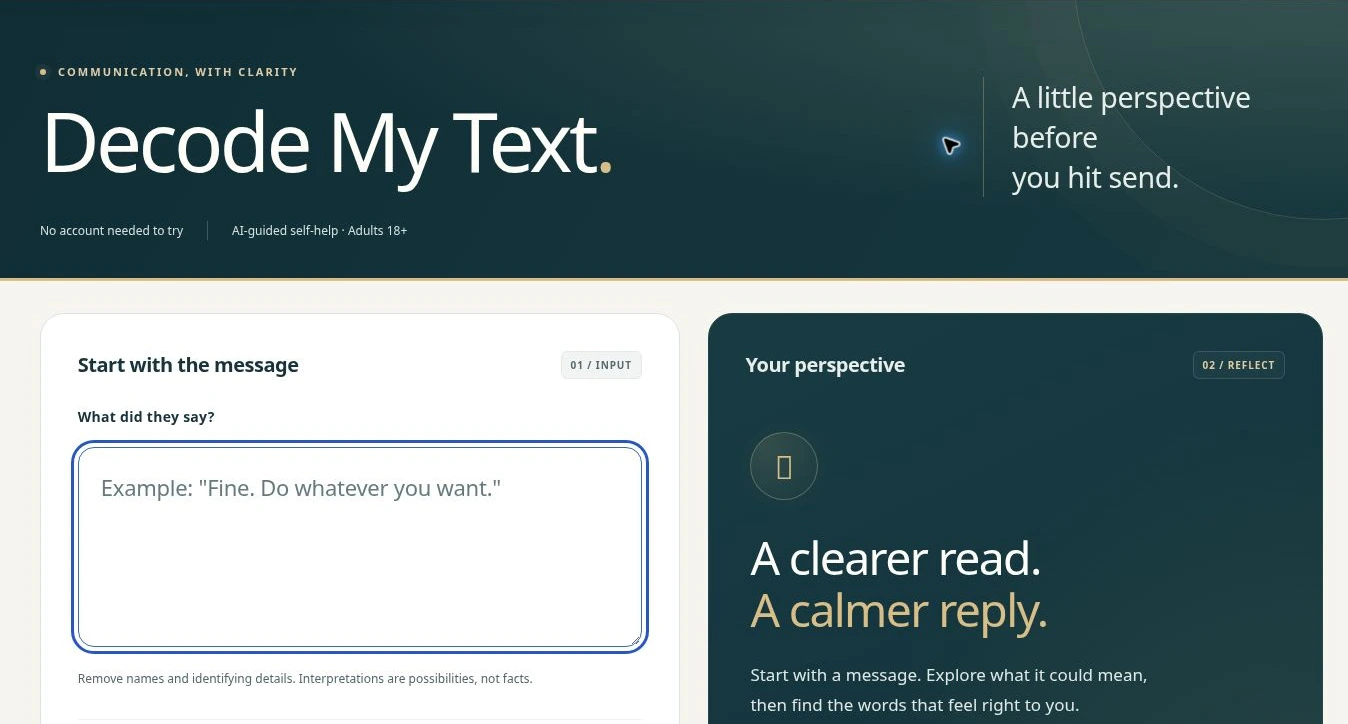
Decode My Text works at the scale of a single incoming message, like the invitation at the start of this story. It can suggest ways of reading the words and help you draft a reply. For a longer exchange, the Relationship Translator lets you add context and say what you want your reply to accomplish. “I want to ask for a different pickup time and still sound appreciative” is a goal it can help you write toward. You can leave out names, addresses and identifying details. Read the suggestion in your own voice before sending anything.
When the argument is over, the job changes. Conflict Debrief gives you a way to look back at what escalated and consider a repair. Say you and your partner disagreed about a late arrival. Halfway through, you started listing every other time it had happened. You might decide to own that shift in one sentence before returning to the practical problem. A workable repair might sound like, “I unloaded three old arguments on you when what I wanted was a heads-up about tonight.” The other person gets to decide how they respond.
Pattern Check makes more sense when you keep recognizing the same exchange. One person asks a question, the other hears criticism and goes quiet, and the first person asks again more urgently. That’s a possible description of a loop. Both people might remember it differently. Bring the description to therapy as a question you can test together. If the tool describes your partner in terms that seem unfair, discard that interpretation. A screenshot gives a tool access to the words on the screen and very little of the life around them.
“We’d like to talk when things are going well, too.”
Daily Connection gives two willing partners one short prompt to answer separately. Once both have answered, the tool builds a shared reflection from their responses. Think of how differently two people might answer a question about when they felt close this week. One remembers a birthday dinner. The other remembers being brought a glass of water while fixing the sink. The interesting part happens when someone says, “I didn’t know you noticed that.” Read the shared reflection together if you wish, and give each other room to correct it. Before answering, consider what you feel comfortable putting in a shared journal.
“I’m wound up, and I have to do something next.”
Present Mode asks what is happening and how much time you have, then guides a short grounding exercise. Picture the few minutes after a tense phone call when the next person you need to talk to is waiting down the hall. You might take that pause, notice how fast you’re speaking and decide to ask for another minute before you join them. The exercise has done enough if it gives you a choice about how to walk into the room.
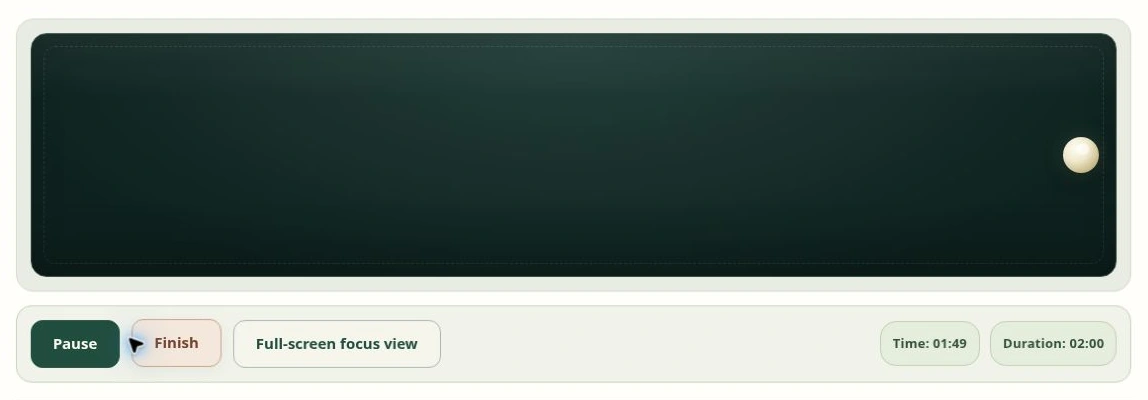
Executive Reset offers a different kind of pause. A visual target moves from side to side, with optional guidance. For someone who spends the day answering words on a screen, a short activity without another paragraph to interpret may be appealing. Stop if following the movement feels uncomfortable. APT offers this as a self-help exercise. Trauma treatment and decisions about whether to use EMDR belong with a trained clinician.
“I’m treating a prediction as if it already happened.”
The CBT Engine uses a structured thought record. Suppose you missed a deadline and thought, “My manager will never trust me with another project.” You can write down what supports that worry and what complicates it. The project was late. Your manager did ask what happened. They also asked for a revised delivery date. A fairer thought might be, “I owe them an explanation and a date I can meet. I don’t yet know what they think about future work.” That gives you a next step and leaves the genuinely uncomfortable uncertainty intact. If you already use thought records with a therapist, ask whether this format fits the work you’re doing together.
A Clarity Session is more suited to a decision. Say a friend needs a ride every Friday and you want to help without promising something you can’t sustain. You could weigh the practical constraints, what each choice would cost, and which parts of a decision you could revisit. Offering a ride this Friday and agreeing to talk again on Sunday is one possibility. The friendship is yours. The part software can help with is putting the actual options into words so you can choose deliberately.
“I want to pick this up again before my next appointment.”
The Growth Hub is a signed-in destination. For someone whose specific goal is to track the ups and downs of the week, the clearest place to begin is Daily Check-In. Clarity and the personal dashboard are free, and a free account lets you keep your check-in history. You choose what goes in. If last week is a blur by the time you see your therapist, a useful experiment is to write down one difficult moment and one surprisingly good one while you still remember them. It helps to keep the two entries side by side, as the next example shows.
How to use a week of mood check-ins in therapy
Consider a fictional client, Elena. On Monday evening, her sister calls while Elena is still at work. They need to decide who will drive their mother to an appointment. Elena says she can do it. An hour later she is standing in the grocery store, looking at the same shelf, running through all the things she will have to move. By the following Monday, when her therapist asks about her week, the appointment has come and gone. “We got through it” would be an honest answer. It would also leave out the part Elena wanted help with.
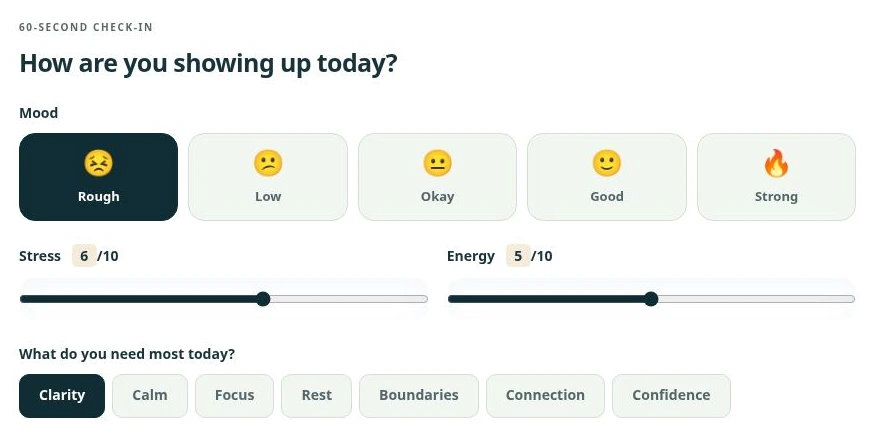
That evening in the store, Elena takes a minute to record her mood, stress and energy. For the question about her biggest pressure, she writes one line in her own words. “I said yes before I even checked my calendar.” She leaves out her mother’s name and the reason for the appointment. Those details belong to her mother. The part Elena wants to remember belongs to her.
On Wednesday her brother calls about groceries. This time she asks for ten minutes to check what she can manage. He offers to do the shopping himself. She feels surprised, then relieved. Later she records an easier evening. On Saturday she feels tense again after a short night of sleep. There is no family request that day. Including Saturday gives her a reason to question her first explanation. A family phone call matters, but it is one piece of a much fuller week.
APT’s Daily Check-In lets adults enter their mood, stress, energy, current needs and what is weighing on them. A signed-in user can return to eligible saved reflections and see recent mood and stress trends. The entries come from the person making them. A blank day could be a lovely afternoon away from a phone or a day when opening an app felt like too much. Only the person who lived it can fill in that part. Explore the Daily Check-In.
How therapists can spend less time reconstructing the week
At her appointment, Elena keeps her phone in her hand and reads the line about saying yes. Then she describes what happened with her brother on Wednesday. She decides to keep the rest of the entries to herself. Her therapist now has two moments to ask about. “What did you imagine would happen if you asked your sister for ten minutes?” Elena says she thought her sister would hear a pause as a refusal. “What made it easier to ask your brother?” That question takes them somewhere the stress ratings alone could never take them.
Elena explains that her brother often asks what she can manage. With her sister, the family has fallen into a shorthand. Both know Elena lives closest to their mother, and both tend to skip the question. Elena wants to keep helping. She also wants her sister to ask. Now there is something specific they can work on together. Elena tries out a sentence in the room, hears how stiff it sounds, laughs, and tries again in the words she would actually use.
That is one way a few notes can change how an appointment is spent. In this example, Elena and her therapist spend less time sorting out which call happened first. They use those minutes to explore why one felt harder, to hear what Elena wants her sister to understand, and to practice saying it. Another client might need most of the hour to tell the story for the first time. The decision about pace belongs in the room. A page of notes is useful for as long as it helps that conversation.
A small agreement a therapist and client can make
A therapist introducing the dashboard could ask, “What do you forget between here and home that you wish we could work on?” One client might say how an argument began. Another might say they forget the days they felt capable. Let the answer decide what’s worth recording. At the next visit, ask whether writing it down helped and whether they would do it again. If keeping a number every night starts to feel like another assignment to fail, a sentence on paper can serve the same purpose.
There’s a practical time boundary on the therapist’s side, too. A clinician who invites a client to bring one example to the next appointment can spend that appointment discussing it. Asking clients to send every entry ahead of time creates a different job, with different expectations about who reads it and when. Agree on that distinction out loud. For a clinician, getting time back can be as simple as asking a good follow-up question sooner. For a client, the gain is having the chance to answer it while there’s still time to work together.
What to share with your therapist and what to keep private
An entry can serve a purpose even if nobody else reads it. Before an appointment, try asking yourself which detail you would struggle to recall, and which you would be glad to discuss. You might read one sentence aloud, jot a question on paper, or describe a low point and a moment that surprised you. APT explains that a therapist does not automatically receive dashboard entries. If you would like your clinician to read something ahead of time, ask the practice which channel it uses, whether anyone reviews messages between visits, and how shared material is handled. How APT describes the personal dashboard.
Deciding what to enter comes earlier still. APT’s privacy policy explains that information submitted to an AI feature may go to a service provider to generate a response. Consider whether a description in your own words would serve the same purpose as uploading another person’s text conversation. For Elena, the important detail was how quickly she agreed. Neither her sister’s messages nor her mother’s medical history was needed to remember that. Read APT’s privacy policy.
A tool can also become one more place to seek reassurance. If you keep returning to a conversation hoping the next answer will finally settle what another person meant, that experience itself may be worth mentioning to someone you trust. When something needs urgent human attention, reach out directly to a person or service equipped to respond. A routine dashboard entry cannot tell a clinician that you need help now.
If you would prefer to start with a person, you can use APT’s therapist directory to look for independent clinicians by location. Ask the practice about fit, cost and availability directly. For someone still exploring, the therapy guides explain different approaches, while the video collection offers short reflections and introductions. APT also lists optional nonclinical coaching separately. You can choose any of these paths without sharing a week of personal reflections with a stranger.
At the end of Elena’s session, the sentence she wants to keep is one she found herself. “I can help. Give me ten minutes to see when.” She can say it without looking at her phone. Her dashboard helped her remember the moment. Her therapist helped her hear the difference between an automatic yes and an answer she actually wanted to give.